Teak vs Bamboo Utensils
Teak or bamboo cooking utensils? Compare water resistance, weight, cracking, staining, care and cost to pick wooden spoons that last in a busy kitchen.
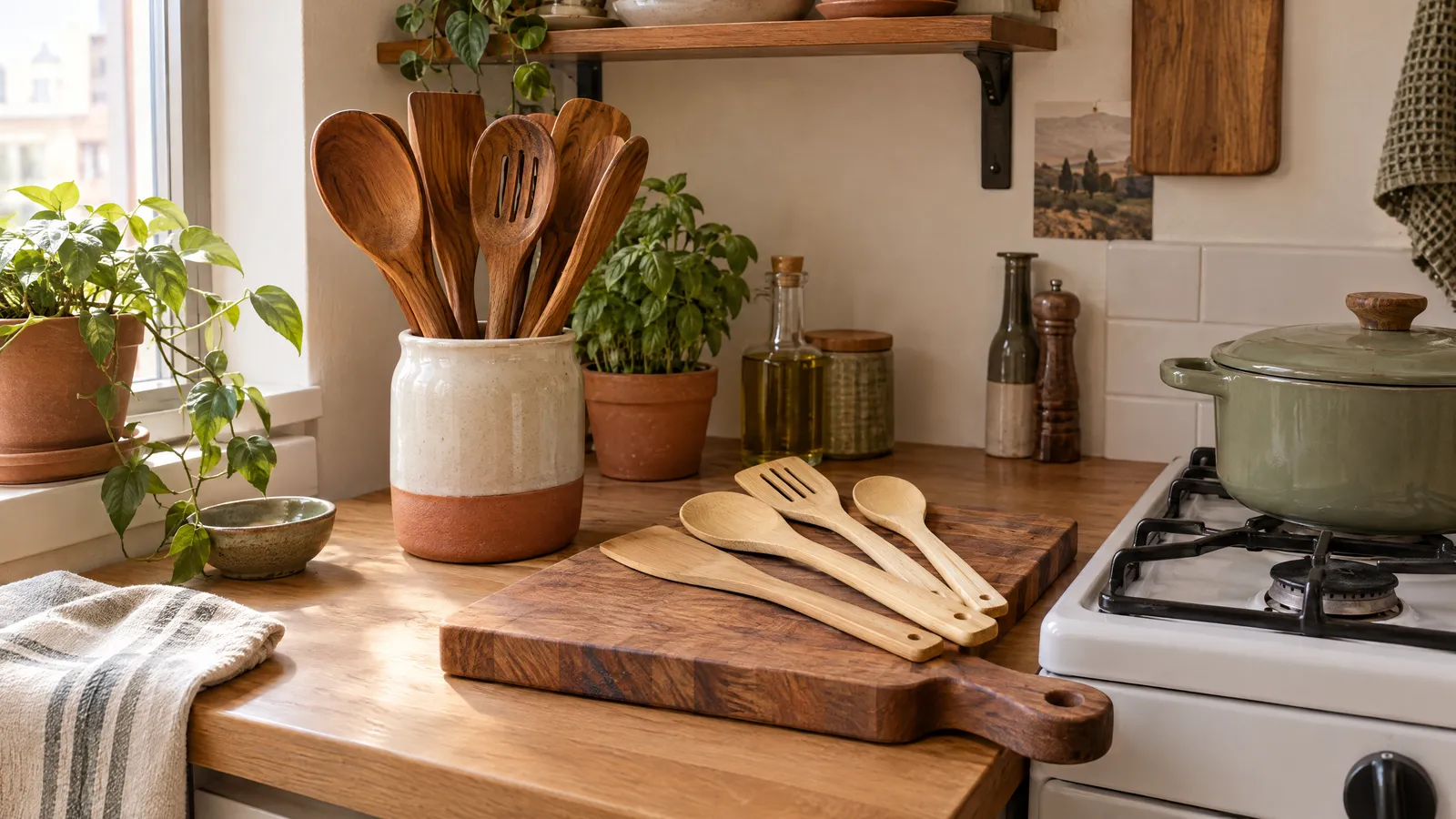
The short answer
Choose teak utensils if you cook most days and want spoons and spatulas that shrug off water, resist cracking and last for years with simple care. Choose bamboo if you want a light, inexpensive set for occasional cooking, a starter kitchen or a second set. Both are gentle on nonstick pans, neither belongs in the dishwasher, and both last far longer if you dry them right after washing.
Side by side
| Teak utensils | Bamboo utensils | |
|---|---|---|
| Material | Tropical hardwood, usually carved from solid pieces | A grass, usually strips glued and pressed into a block |
| Natural oils | High; helps shed water | Low; relies on its finish |
| Water resistance | Good | Fair; glue lines can open if soaked |
| Weight | Heavier, solid feel | Light |
| Cracking and splitting | Resistant with basic care | More prone at glue lines and thin edges |
| Staining | Darker color hides stains | Pale color shows tomato and turmeric |
| Typical length | About 12 to 13 inches (30 to 33 cm) | About 12 to 13 inches |
| Dishwasher | No | No |
| Cost level | Higher | Usually cheaper |
When teak is the better buy
Teak is the better buy if your utensils see daily use. The wood is dense and naturally oily, so it absorbs less water than most woods. That means less swelling, fewer cracks and less of the fuzzy, raised grain that cheap wooden spoons develop after a few washes.
It also feels solid in the hand. A teak spatula has enough weight to scrape a pan or stir a thick sauce without flexing, and the smooth finish improves with regular oiling.
Teak’s warm golden-brown color deepens over time and hides stains from sauces and spices. Our guide to teak wood utensil sets covers how many pieces you need and what to check for quality.
Look for wood described as responsibly sourced or plantation-grown when you can, and for one-piece utensils rather than ones with glued-on handles.
When bamboo is the better buy
Bamboo is the better buy when budget or weight matters most. Bamboo sets are usually much cheaper, and the light weight makes them easy for kids and for anyone who finds heavy tools tiring.
It also grows quickly, which is why it’s often marketed as a renewable choice. Bamboo is usually as hard as or harder than many hardwoods, so a well-made piece holds a thin, crisp edge on a spatula or turner.
The weak point is construction. Most bamboo utensils are made from strips glued together, so soaking and dishwasher heat can loosen the glue and split the piece along a seam. Choose sets with smooth, sealed surfaces and no visible gaps between strips. Bamboo is a good pick for a first apartment or a backup set that you replace without worry.
What to look for in either set
The material matters, but so does how the pieces are made. Check these before you buy:
- One-piece construction. Utensils carved or cut from a single piece have no joints for water to get into. Avoid glued-on handles.
- A smooth, even finish. Run a hand over the surface and edges. Rough spots and splinters only get worse with washing.
- An oil finish, not a thick lacquer. A food-safe oil finish can be refreshed at home. Shiny varnish or lacquer can chip and flake over time.
- Thin, straight edges on spatulas and turners. A thin front edge slides under eggs and pancakes; a thick, blunt one pushes them around the pan.
- A hole or loop in the handle if you plan to hang them on a rail.
In a small space
In a small kitchen, a utensil set has to share counter and drawer space with everything else. Five or six pieces cover most cooking: a spoon, a slotted spoon, a flat spatula, a turner and a ladle or scraper. A bigger set often adds duplicates you rarely use.
Store them upright in a crock about 4 to 5 inches (10 to 13 cm) across, or hang them from a rail or hooks on the wall beside the stove. Upright storage lets the wood dry fully between uses, which matters more for wood than for metal or silicone.
Keep the crock a little back from the burners. Wood won’t melt like plastic, but resting it on a hot pan edge or near an open flame scorches it. For more ways to fit a full kitchen into one room, see our studio apartment guide.
Care and lifespan
The same routine works for both woods:
- Wash by hand in warm, soapy water right after cooking.
- Don’t leave utensils soaking in the sink.
- Dry them with a towel, then let them air dry upright.
- Rub on a thin coat of food-safe mineral oil or board oil when the wood looks pale or dry, often once a month. Let it soak in, then wipe off the excess.
- Sand rough or raised grain lightly with fine sandpaper, then oil again.
Skip the dishwasher for both. Long hot cycles and harsh detergent dry out the wood, raise the grain and break down glue on bamboo.
Replace any utensil with deep cracks, a split along a seam or a soft, dark patch that doesn’t clean up. Those spots hold moisture and food. Cared for this way, teak often lasts for many years, and a well-made bamboo set usually gives you a few years of everyday cooking.