Wood-Burning vs Propane Fire Pits
Wood-burning vs propane fire pits compared on heat, smoke, fuel, cost, cleanup and local rules, plus the clearances and safety steps for a small patio.
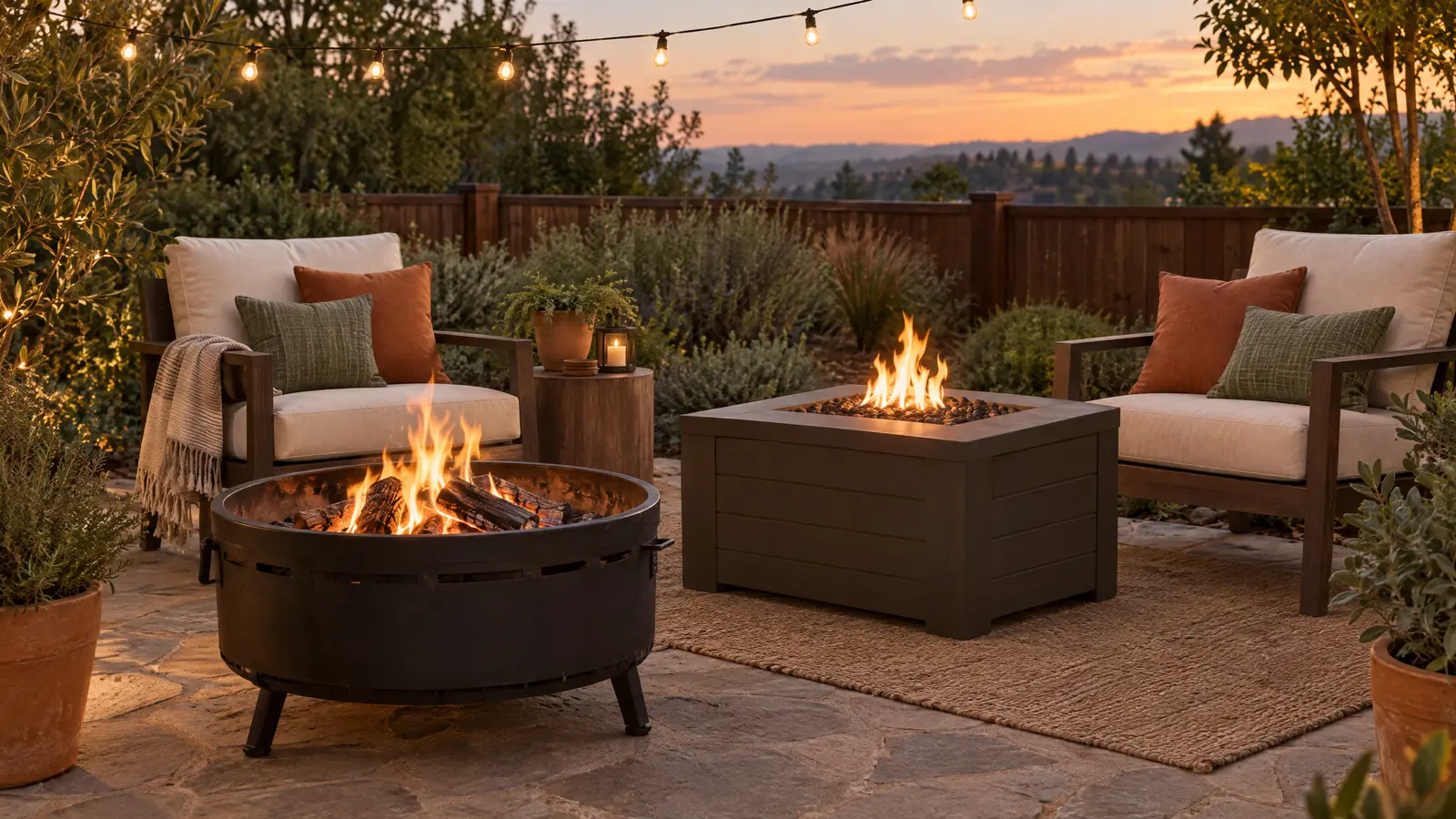
The short answer
Choose a wood-burning fire pit if you have a yard or ground-level patio with room to spare, want real heat, crackle and the option to toast marshmallows, and your local rules allow open wood fires. Choose a propane fire pit if you want instant on and off, no smoke or sparks, and less cleanup, or if your neighbors are close and your rules ban wood fires. On an apartment balcony, the usual answer is neither: check your lease and local fire code first.
Side by side
| Wood-burning fire pits | Propane fire pits | |
|---|---|---|
| Heat | Strong radiant heat that reaches farther | Usually rated around 30,000 to 60,000 BTU per hour; gentler, steady heat |
| Smoke and sparks | Smoke and flying embers; less with dry wood and double-wall designs | No smoke, no sparks, no ash |
| Fuel | Seasoned firewood | Standard 20-lb (9 kg) tank or a hookup; small pits may use 1-lb canisters |
| Burn time | As long as you feed it | A 20-lb tank typically lasts about 8 to 10 hours at 40,000 to 50,000 BTU |
| Start and stop | Takes time to light and hours to burn out | Turns on and off with a knob |
| Cleanup | Ash and coals to remove once cold | Wipe the burner area; check the hose |
| Cooking | Can roast over it with the right grate | Most aren’t designed for cooking; check the manual |
| Cost level | Low to mid upfront; firewood is an ongoing cost | Mid to high upfront; refills or tank exchanges ongoing |
| Rules | Often banned by cities and buildings, and during burn bans | Allowed in more places, but still often restricted |
When a wood-burning fire pit is the better buy
Wood gives the classic fire: crackle, smell, glowing coals and the most heat. If you have a backyard with space around it and want a gathering spot on cool evenings, a wood fire is hard to beat. Our guide to iron fire pits covers the bowl and ring styles that suit small yards.
Burn only dry, seasoned firewood. Wet or green wood smokes heavily, sparks more and annoys neighbors. Never burn trash, treated lumber, pallets or painted wood, which can release toxic fumes.
Placement matters more than the pit. Keep any wood fire at least 10 feet (3 m) from the house, fences, sheds and anything that burns, and never under a roof, awning, umbrella or tree branches. Follow the manual if it asks for more. Set the pit on stone, pavers, gravel or bare soil, not on a wooden deck or dry grass, unless the maker sells it with a heat shield rated for that surface. A spark screen is worth using every time.
Have a way to put it out: a hose, a bucket of water or a fire extinguisher within reach. Embers stay hot for hours, so drown the fire, stir, and drown again before you go inside.
When a propane fire pit is the better buy
Propane trades a little drama for convenience. You turn a knob and get a flame within seconds, and you turn it off when you’re done with nothing left to watch. There’s no smoke drifting into a neighbor’s window, no sparks and no ash, which matters on a small patio with fences close by.
Heat is steadier but gentler than a big wood fire, so propane pits work best as a warm focal point for two to four people sitting close rather than a bonfire for a crowd.
Treat the tank with care. Check connections for leaks with soapy water each time you connect a tank; bubbles mean a leak, so shut the valve and fix it before lighting. Store tanks outdoors, upright, away from heat and never inside your home, a garage or a basement. Before the first use each season, check the burner and hose for cracks, debris and insect nests.
Propane fire pits still need clearance. Follow the manual’s distances to walls, furniture and anything overhead, and keep them off enclosed porches and covered balconies.
In a small space
Start with the rules, not the product. Many apartment buildings, condo associations and city fire codes ban wood fires, and many also restrict propane tanks and open flames on balconies. Never use either type on a wooden or covered balcony unless your building and local rules clearly allow it. Check burn bans in dry or windy weather, which can cover propane too.
Never use any fire pit indoors, in a garage, in a tent or in an enclosed porch. Both wood and propane produce carbon monoxide, which can build up to dangerous levels without you noticing.
On a small ground-level patio, propane is usually the easier fit: no smoke drifting toward windows and no woodpile to store. If you want a small flame on a table rather than a full pit, see our guide to tabletop fire pits, and follow the same rules on clearance and supervision.
For light without a flame, outdoor string lights or solar lights add a lot of the same mood; see our comparison of solar and plug-in outdoor lights.
Care and lifespan
Wood: remove ash once it’s completely cold, since wet ash is corrosive to steel. Keep drainage holes clear so rainwater doesn’t pool, and cover the pit between uses. Steel and iron bowls rust over time; a high-heat paint touch-up slows it.
Propane: cover the unit, keep the burner ports clear of debris, and disconnect the tank when it’s not in use. Replace a damaged hose, regulator or valve with a part the maker approves rather than patching gas parts yourself. Never leave either kind of fire unattended, and keep children and pets well back from the pit while it’s lit and cooling down.