Solar vs Plug-In Outdoor Lights
Solar vs plug-in outdoor lights compared on brightness, winter reliability, setup, weather ratings and cost, with which suits a balcony, patio or small yard.
The short answer
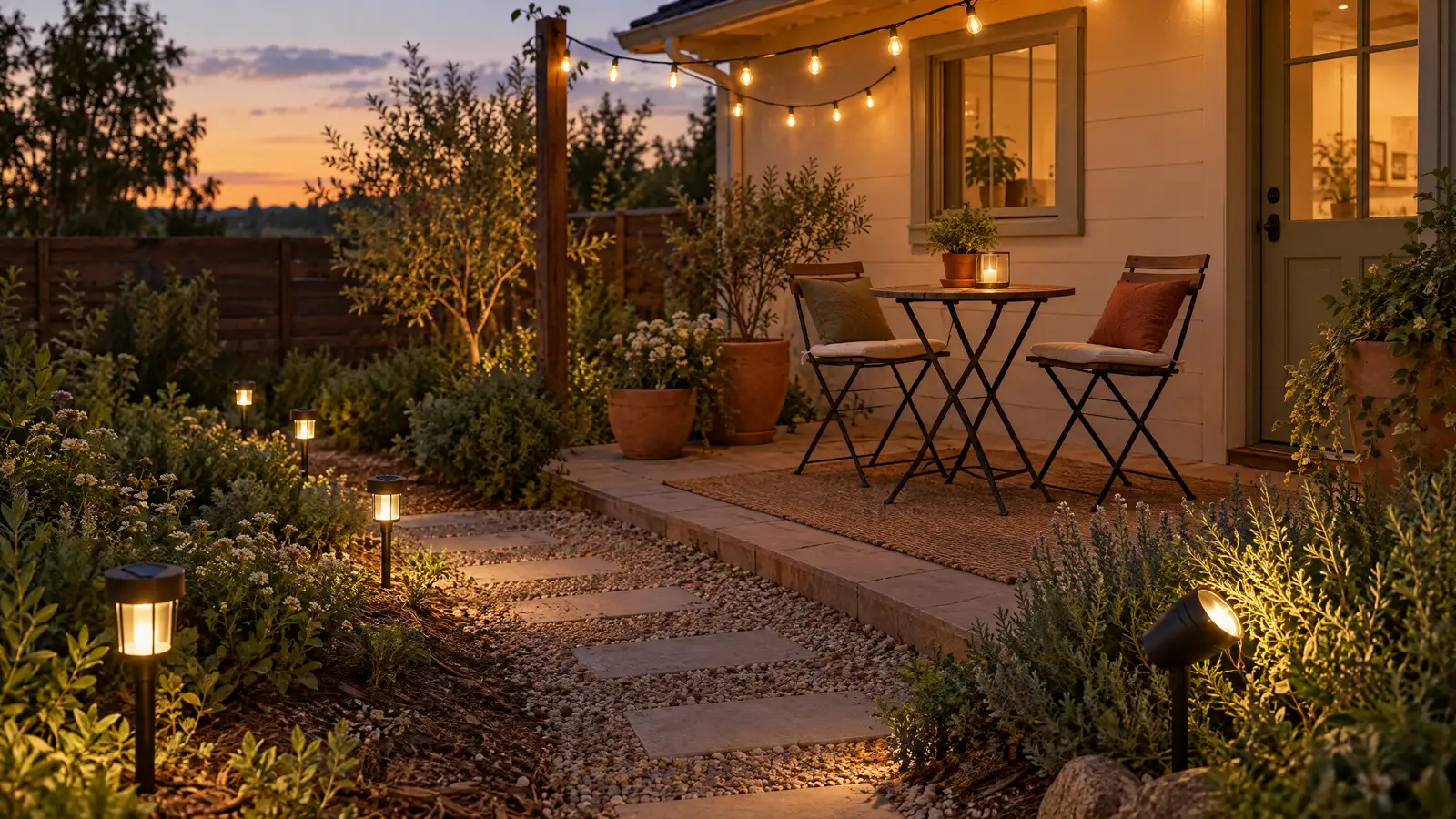
Choose solar lights if you want to mark a path, light up a plant or add a soft glow in a sunny spot, with no wiring and no outlet. Choose plug-in lights if you want bright, dependable light every night of the year, for seating, steps or security, and you have an outdoor-rated outlet nearby. Many small yards and patios use both: solar along the edges, plug-in where people sit and walk.
Side by side
| Solar outdoor lights | Plug-in outdoor lights | |
|---|---|---|
| Power | Small panel charges a built-in battery by day | Outdoor-rated outlet, often through a plug-in transformer or timer |
| Brightness | Path lights often tens of lumens; spotlights more, often a few hundred | As bright as you choose; consistent all night |
| Reliability | Drops after cloudy days and in short winter days | Same every night |
| Run time | Often 6 to 10 hours after a full sunny day | Unlimited; set by a timer or dusk sensor |
| Sun needed | Usually 6 to 8 hours of direct sun for a full charge | None |
| Installation | Push into soil or screw to a wall; no wiring | Needs an outdoor GFCI outlet and cord routing |
| Weather rating | Look for at least IP44; IP65 for exposed spots | Same; cords and plugs must be outdoor-rated |
| Running cost | None | Small with LEDs |
| Upkeep | Wipe panels; replace batteries every year or two | Check cords, plugs and covers each season |
When solar lights are the better buy
Solar lights are the no-wiring option. You push them into a bed or bolt them to a wall, and they come on by themselves at dusk. There are no cords to trip over, no outlet to find and no electricity bill, which makes them the easy way to mark a path, outline a garden bed or light up a shrub.
Sun is the whole game. A solar light needs direct sun on its panel for most of the day, often 6 to 8 hours, to run for most of the night. Under a tree, against a north-facing wall in the Northern Hemisphere, or in a deep balcony that gets shade, it may only glow briefly. In winter, with short days and low sun, expect shorter run times everywhere.
For lighting a feature like a tree, a sign or a doorway, a solar spotlight with a separate panel gives you more freedom: the light goes where you need it and the panel goes where the sun is. To compare options, see our guide to solar LED spotlights.
Point lights down and away from windows, both your neighbors’ and your own. Warm white, around 2700 to 3000K, looks softer at night than bright cool white.
When plug-in lights are the better buy
Plug-in lights give you the same bright light every night, regardless of the weather. That’s what you want over a seating area, on steps, by a door or anywhere you need to see clearly. String lights over a patio, a wall lantern near the entrance or a low-voltage path kit on a timer all fall into this group.
They need the right power source. Use only an outdoor outlet protected by a GFCI (ground-fault circuit interrupter), with a weatherproof “in-use” cover that stays closed while something is plugged in. Use only extension cords and lights marked for outdoor use, and don’t run cords through doors or windows where they get pinched.
Water is the main hazard. Keep plugs and cord connections off the ground and away from puddles, planters you water, pools and hot tubs. Let each cord hang in a small loop below the outlet so rain drips off rather than running into the socket. Don’t staple through a cord; use clips or hooks made for light strings.
A timer or dusk-to-dawn sensor makes plug-in lights as easy as solar day to day. LED strings and fixtures draw little power, so running costs stay small.
In a small space
On a balcony, check your sun first. A south- or west-facing balcony in the Northern Hemisphere usually charges solar lights well; a north-facing or heavily shaded one usually doesn’t. Check your building’s rules on outdoor outlets, cords and anything attached to railings before you buy.
Renters often have no outdoor outlet at all, which makes solar or rechargeable lights the practical choice. Don’t run an indoor extension cord out through a window or balcony door to power outdoor lights. For a balcony full of plants, our guide to a balcony garden for beginners covers sun, space and layout.
On a small patio, a single run of plug-in string lights over the seating area plus a few solar lights along the edges usually gives the best result for the money. If you’re planning an evening spot around a fire, see our comparison of wood-burning and propane fire pits for clearance and safety.
Care and lifespan
Solar: wipe the panels every few weeks; dust, pollen and bird droppings cut charging a lot. Many solar lights use rechargeable AA or AAA batteries that wear out in a year or two; replacing them with the same type and capacity often brings a dim light back to life. Bring cheap solar lights indoors in harsh winters if they aren’t rated for freezing weather.
Plug-in: before each season, look over cords, plugs and bulbs for cracks or damage, and replace anything damaged rather than taping it. Unplug strings during storms and take seasonal lights down rather than leaving them up all year unless they’re made for permanent outdoor use. Well-made LED lights of either kind typically last many seasons.