Wood vs Metal Shelving
Wood vs metal shelving for small homes: load ratings, sagging, humidity, assembly, looks and cost compared, plus which material suits each room best.
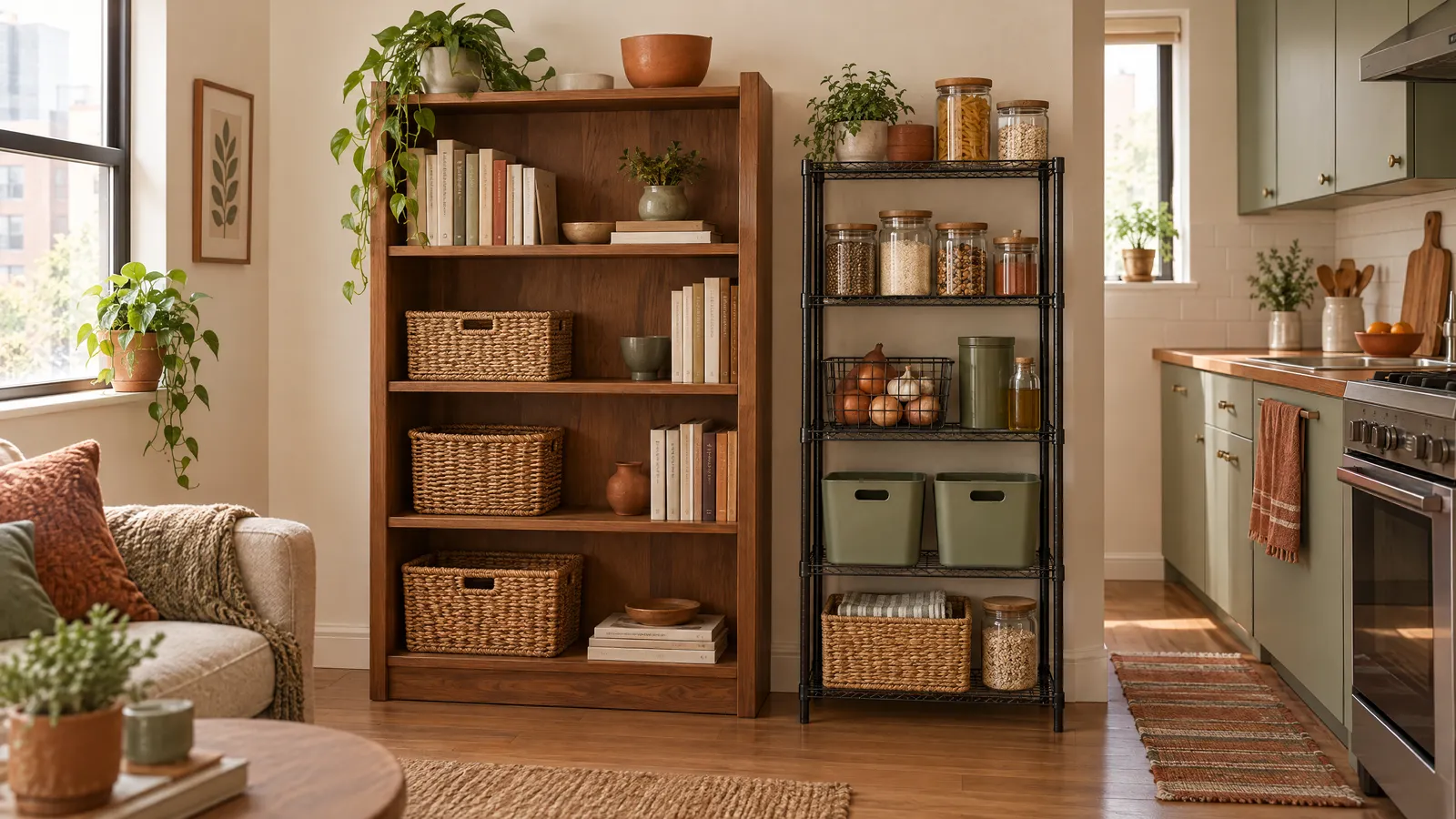
The short answer
Choose wood shelving if it will stand in a living room, bedroom or entryway where it needs to look like furniture, and it will carry books, baskets and decor. Choose metal shelving if it lives in a kitchen, pantry, bathroom, laundry nook or garage, or if it will hold dense, heavy things like canned food, small appliances or tools. In a small home, metal usually holds more per dollar, and wood usually looks better.
Side by side
| Wood shelving | Metal shelving | |
|---|---|---|
| Load per shelf | Particleboard often 20 to 50 lb (9 to 23 kg); solid wood more on short spans | Light units often 30 to 80 lb (14 to 36 kg); heavy-duty steel often 200 lb (90 kg) or more |
| Sagging | Particleboard bows over long spans; a common rule of thumb is to keep book spans under about 30 inches (76 cm) | Steel shelves rarely sag; wire decks can dip under one heavy point load |
| Damp and steam | Particleboard swells if edges get wet; solid wood can warp | Powder-coated or chrome units cope well; bare steel and chips in the coating rust |
| Unit weight | Heavier for the same size | Lighter, easier to move |
| Assembly | Flat-pack with cam locks and screws; usually not adjustable after | Wire units often clip together without tools and adjust in 1-inch (2.5 cm) steps |
| Typical depth | Bookcases usually 10 to 12 inches (25 to 30 cm) | Wire units usually 14 to 18 inches (36 to 46 cm) |
| Looks | Warm, reads as furniture | Utilitarian; black finishes look softer than chrome |
| Cost level | Particleboard cheapest; solid wood highest | Low to mid for wire; more for heavy-duty steel |
When wood is the better buy
Wood belongs in rooms where shelving is part of the decor. A short solid-wood unit beside a sofa or bed looks like furniture, not storage, and suits books, framed photos and baskets. Our guide to 2- and 3-tier wood shelves covers the low units that double as side tables or entryway drop zones.
Know what you’re buying. Solid wood is the strongest and can be sanded and refinished. Plywood is close behind and holds screws well. Particleboard and MDF are the budget options: fine for light loads, but they sag over long spans and crumble at the edges if they get wet. Books are heavier than they look, so a particleboard shelf full of hardcovers is the classic sagging shelf.
Wall-mounted wood shelves free up floor space, which counts in a small room. Our guides to hanging wood storage shelves and suspended wall shelves cover rope- and bracket-hung styles. For an empty corner, our guide to 5-tier corner shelves shows how to use space most furniture can’t reach.
When metal is the better buy
Metal wins wherever there’s weight, moisture or heavy use. A powder-coated or chrome wire unit shrugs off steam, wipes clean, and lets air move around what’s stored, so it suits pantries, laundry corners and bathrooms. Shelves on most wire units slide up or down in small steps, so you can set the gaps to fit cereal boxes, paper towels or a stand mixer. Our guide to storage shelf organizers compares sizes and load ratings.
Check the rating per shelf as well as the total, and spread the load. Heavy things go on the lower shelves, which also makes a tall unit less likely to tip.
Wire decks have one weakness: small items tip over or fall through. A shelf liner or a sheet of thin plywood on each deck fixes it. For a pantry, our guide to pantry organization on a budget covers how to group items so a wire unit stays tidy.
Metal also opens up surfaces you might not count as storage. Magnetic racks stick to the side of a refrigerator or washer and hold spices, foil and cleaning spray without screws. Many stainless-steel fridge doors aren’t magnetic, though, so test the spot with a fridge magnet before you buy.
In a small space
Depth matters more than width. A 12-inch (30 cm) bookcase fits a narrow hallway where an 18-inch (46 cm) wire unit would block the path, so measure the walkway as well as the wall. As a rule of thumb, leave at least 30 inches (76 cm) of clear floor in front of shelving you walk past every day.
Go tall, but anchor it. Any freestanding unit taller than about 3 feet (0.9 m) should be fixed to the wall with the anti-tip strap or bracket that comes with it, especially with children or pets at home. In a rental, ask your landlord; one small screw hole is usually easy to patch.
Open wire shelving looks lighter than a solid bookcase because light passes through it, which helps in a tight room. If the metal look feels too utilitarian, use matching fabric bins or baskets on the front edge to soften it.
For wall-mounted shelves of either material, find the studs or use anchors rated for the full load, using the weight rating on the package. A loaded shelf weighs far more than the board itself.
Care and lifespan
Wood: dust with a soft cloth, wipe spills right away, and use a tray or saucer under plants. Keep particleboard away from steam and splashes. Solid wood can be oiled or refinished every few years, and a well-made unit lasts decades.
Metal: wipe with a damp cloth and dry it, especially in a bathroom. Touch up chips in a painted or powder-coated finish with matching paint before rust starts. Retighten bolts and check that shelf clips are fully seated after a move. A good wire or steel unit typically outlasts several homes, and it comes apart flat when you move.