How to Make Your Home Feel Cozy
Seven simple ways to make your home feel cozy and inviting: warm lamp light, soft layers, a bigger rug, clear surfaces, gentle scent and things you love.
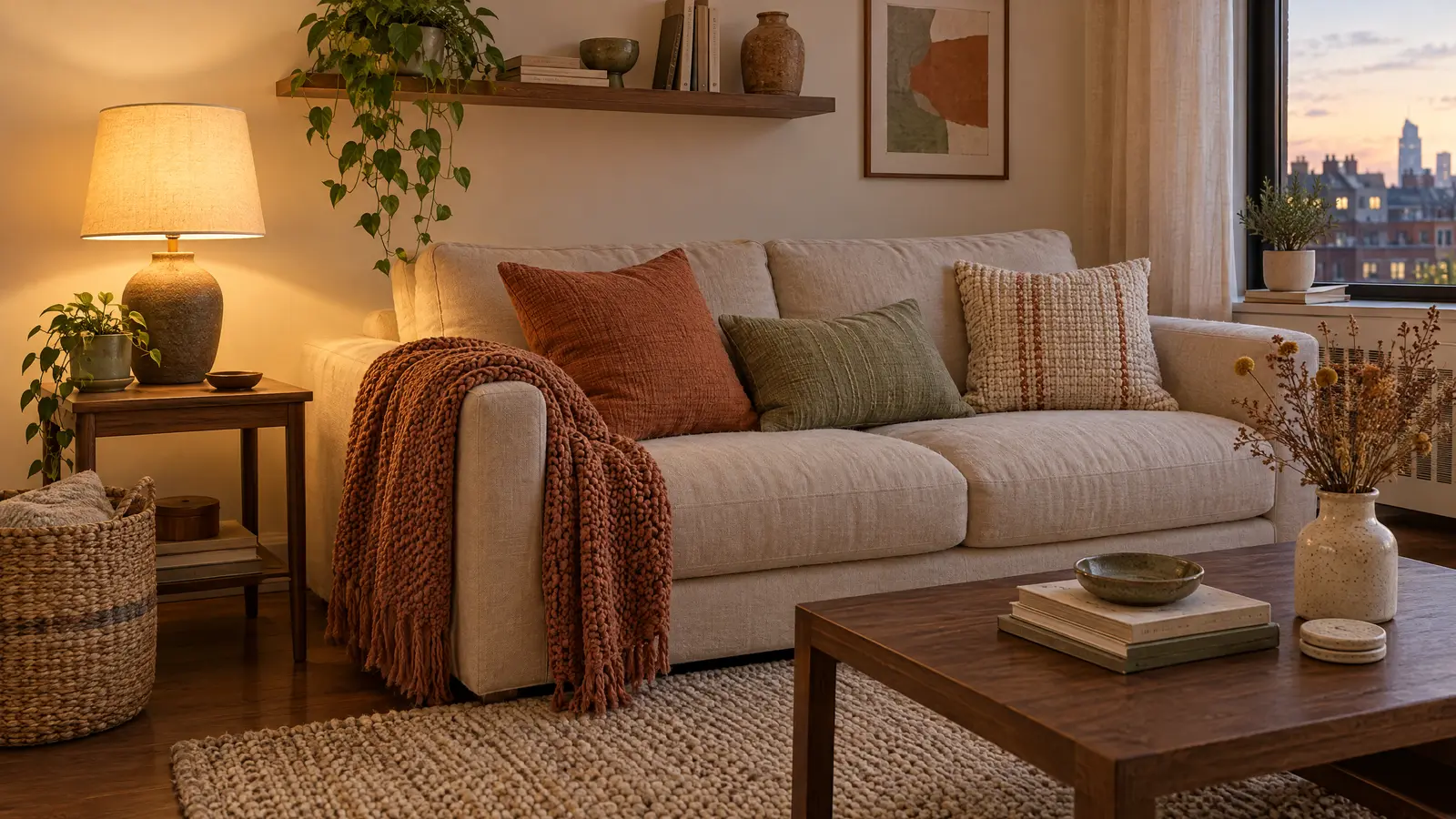
What makes a home feel cozy
A room feels cozy when it is warm to look at, soft to touch and easy to relax in. In practice that comes down to a few changes: warmer and lower light, layered textiles, something soft underfoot, fewer things on every surface, and a handful of objects that are clearly yours.
None of it needs a renovation or a big budget, and all of it works in a rental. Start with light, because it changes the feel of a room more than anything else you can buy, then work down the list below one room at a time.
What you need
- A tape measure, to check lamp heights and rug sizes before you buy
- Two or three warm-white bulbs (2700K or lower) for the lamps you already own
- One throw blanket and two pillow covers in a texture the room doesn’t have yet
- A lidded basket or a tray for the things that pile up on surfaces
- An hour to clear and reset one room first
7 simple ways to make your home feel cozy
1. Switch to warm, low light
A single overhead light makes a room look flat. Aim for three light sources in each main room, at different heights: a table lamp, a floor lamp or wall light, and something small such as a lamp on a shelf or a string of warm lights.
Bulb color matters as much as the lamp. Look for 2700K or lower on the box; that is the warm white of an old incandescent bulb, while 4000K and above reads cool and office-like. For reading, about 800 lumens (roughly a 60-watt equivalent) is usually enough; 450 lumens (about a 40-watt equivalent) suits an accent lamp. A dimmer or a lamp with a low setting lets you bring the light down in the evening.
Size the lamp to the seat next to it. Beside a sofa, the bottom of the shade usually looks right near seated eye level, roughly 38 to 42 inches (97 to 107 cm) from the floor, so you see the glow and not the bulb. Our guide to modern neutral table lamps covers shade sizes and heights.
2. Layer soft textiles
Cozy rooms have more than one texture: a knit or fleece throw, linen or velvet pillow covers, a wool or cotton rug, curtains. Pick fabrics you want to touch, and repeat each color at least twice in the room so it looks planned.
A throw is usually about 50 by 60 inches (127 by 152 cm), enough to cover one person on a sofa. Fold it over the arm or the back where you can reach it. For pillows, 18- and 20-inch squares are the common sofa sizes, and an insert 1 to 2 inches larger than the cover looks fuller. Two to four pillows suit most sofas; more than that and you have to move them to sit down.
Swapping covers is an easy seasonal change: keep the inserts and change only the covers. Our guides to Scandinavian throw blankets and throw pillow covers explain fabrics and sizes.
Curtains count too. Hang the rod about 4 to 6 inches (10 to 15 cm) above the window frame and 6 to 10 inches past each side, with panels that just touch the floor. The window looks bigger, and lined panels cut drafts on cold nights.
3. Put something soft underfoot
A bare floor makes a room sound and feel colder. A rug softens echo, warms your feet and pulls the furniture into one group.
Size it so at least the front legs of the sofa and chairs sit on it. In a small living room that usually means 5 by 8 feet (152 by 244 cm); a 4-by-6 rug floating in front of the sofa tends to look like a doormat. Leave roughly 8 to 18 inches (20 to 46 cm) of bare floor between the rug and the walls. On hard floors, put a non-slip pad underneath for grip and extra cushioning.
4. Clear the surfaces you look at
Clutter reads as unfinished, not cozy. You don’t need to own less, but the surfaces you see from the sofa or the bed should be mostly clear.
A useful rule of thumb is to leave about a third of each surface empty. Give the things that pile up a home: a lidded basket by the sofa for throws and chargers, a tray by the door for keys and mail, a small box for remotes. Then spend 10 minutes each evening putting everything back, so the room starts fresh the next day.
5. Add a gentle scent
Scent is a big part of what makes a home feel inviting when you walk in. Keep it light: one scent per room, strong enough to notice as you enter and faint after a few minutes.
A reed diffuser runs on its own with no power, and an electric diffuser can be switched on only when you want it. Our guide to home diffusers compares the types. Essential oils need care around pets, especially cats and birds, and around babies and young children, so check before using them in shared rooms, keep diffusers out of reach and leave a door or window open for airflow.
If you light candles, keep them at least 12 inches (30 cm) from anything that can burn, put them on a stable heat-safe surface and never leave them unattended. A flameless candle gives a similar glow without the risk.
6. Bring in natural materials and something living
Wood, wool, linen, cotton, ceramic, rattan and stone all look warmer than glossy plastic and chrome. Swap one or two items: a wooden tray, a ceramic lamp base, a woven basket for the throw.
Plants do the same job. One medium plant in a 6- to 8-inch (15 to 20 cm) pot does more than several tiny ones on a sill. Many common houseplants, including pothos and snake plant, are toxic to cats and dogs if chewed, so check a plant before you bring it home if you have pets. Dried stems in a vase are a low-effort alternative.
7. Show the things you love
A cozy home looks like someone lives there. Put out the books you are reading, a bowl from a trip, framed photos, a child’s drawing. Group small objects in odd numbers, since three usually looks more natural than two or four, and vary their heights.
Hang art at eye level, with the center of the piece about 57 inches (145 cm) from the floor. Above a sofa, leave 8 to 10 inches (20 to 25 cm) between the sofa back and the bottom of the frame. If you have lots of small pictures, our guide to hanging a gallery wall walks through layout and spacing.
Small-space tips
- Make one cozy corner first. In a studio or a small living room, a chair, a lamp, a small side table and a throw in one corner give you the feeling without redoing the whole room. A compact armchair usually needs about 30 by 30 inches (76 by 76 cm) of floor.
- Pick lamps with a small footprint. A slim floor lamp takes about a foot of floor, and a plug-in wall light takes none. Run the cord in a paintable cord cover rather than drilling for wiring in a rental.
- Use a rug and a lamp to zone a studio. Together they mark out a living area as clearly as a wall does.
- Keep the palette tight. Three or four colors, such as oat, rust, sage and walnut, keep a small room calm. Many colors in a small room look busy.
- Let a mirror bounce the lamp light. A mirror beside or across from a lamp spreads its glow in the evening.
- Keep textiles to scale. Pillows of 24 inches and up eat seat depth on a small sofa; 18-inch covers suit most apartment sofas.
Mistakes to avoid
- Relying on the overhead light. It flattens the room. Add lamps and save the ceiling light for cleaning.
- Mixing bulb colors. A 2700K lamp next to a 5000K bulb makes both look wrong. Keep one color temperature per room.
- Buying decor before clearing. New things on top of clutter just add clutter. Clear first, then decide what is missing.
- Too many small things. Lots of little objects read as mess. Fewer, larger pieces look calmer.
- Overdoing scent. Several scented products in a small apartment compete with each other. One per room, lightly.
- A rug that’s too small. A rug that doesn’t touch any furniture makes the room look smaller, not cozier.
Questions people ask
What makes a room feel cozy?
Warm, low light from several lamps, soft textures you want to touch, a rug underfoot and surfaces that are not crowded. Add natural materials such as wood, wool and ceramic, a light scent and a few personal things like photos and books. Lighting does the most work: switching to 2700K bulbs and adding a table lamp or two changes how a room feels more than any single piece of decor.
How can I make my apartment feel cozy on a budget?
Start with what you already own. Swap cool bulbs for 2700K warm white, move lamps so every seat has one nearby, and clear about a third of each surface. Then add the cheapest soft things: a throw blanket, two new pillow covers over your existing inserts and a basket for clutter. Plants, thrifted frames and your own books cost little and make a room feel lived in.
What color light bulb is best for a cozy room?
Warm white, rated 2700K or lower on the box. That matches the soft yellow glow of old incandescent bulbs. Bulbs at 3000K are a little crisper and suit kitchens and bathrooms, while 4000K and above look cool and office-like in a living room or bedroom. Keep every bulb in one room at the same color temperature, and choose dimmable bulbs if the lamp or switch has a dimmer.
How do I make a rental feel cozy without painting?
Focus on things you can take with you when you move. Use lamps instead of changing ceiling fixtures, lay a large rug over cold floors, hang curtains high and wide, and pick textiles in three or four colors that repeat around the room. Lean art on shelves or use renter-friendly hanging options, then add plants and baskets. None of it touches the walls or needs your landlord's approval.