Small Entryway Ideas: Storage, Mirror and Light
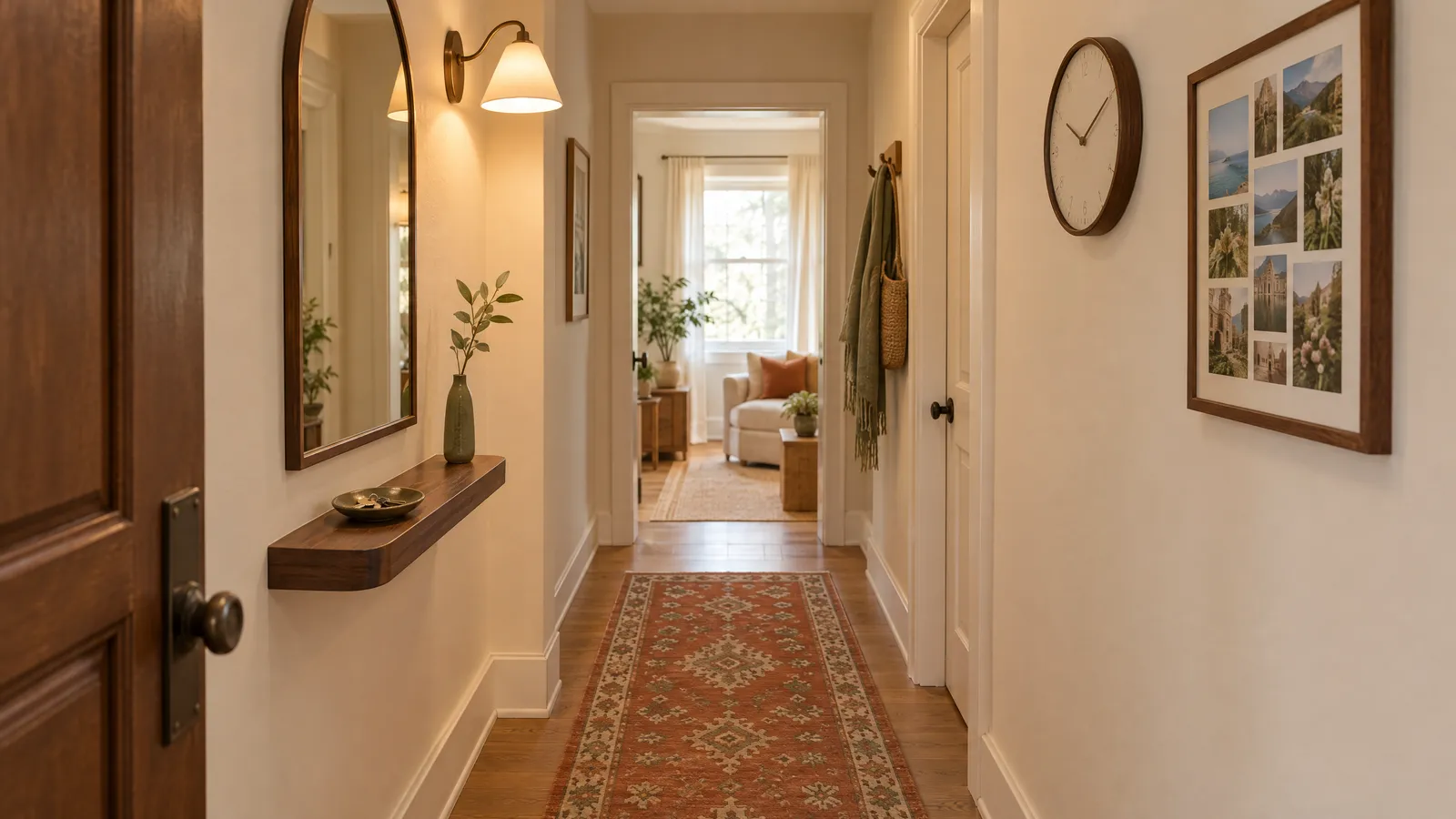
Make a narrow entryway work harder: a shallow shelf for keys, a mirror that widens the hall, a runner that takes the wear and seasonal decor within the rules.
The problem
In most apartments the entryway is the first 4 to 6 feet of a hallway, often 36 to 42 inches (91 to 107 cm) wide, with the front door swinging into it. An entry door is usually 32 to 36 inches (81 to 91 cm) wide, so it sweeps an arc about that deep across the floor every time it opens. Anything in that arc, from a shoe pile to a curled rug edge, gets hit, pushed or tripped over.
Yet this is where everything lands: keys, mail, bags, shoes, umbrellas and packages. A typical console table is 12 to 16 inches (30 to 41 cm) deep, and in a 36-inch hall that leaves only 20 to 24 inches to walk through, which is tight with a bag on your shoulder. So the drop zone moves to the floor or the kitchen counter instead.
Light is the other problem. An interior hall often has no window and a single ceiling fixture, so it reads as a dark tunnel. And in a rental you’re limited on holes, heavy mirrors need real hardware, and the outside of your front door may fall under the building’s fire rules rather than your own taste.
The plan
-
Mark the door swing and the walking line. Open the door fully and mark its arc on the floor with painter’s tape, then mark a 30-inch (76 cm) walking path down the hall. Nothing goes on the floor inside the arc or the path. In a 36-inch hall that leaves about 6 inches, which is why most of this plan lives on the wall.
-
Put a shallow shelf where your hand goes. A drop spot by the door stops keys and mail from scattering through the home. A hanging wood storage shelf 4 to 6 inches (10 to 15 cm) deep holds keys, sunglasses and the day’s mail without sticking out into the walkway. Hang it about 36 to 48 inches (91 to 122 cm) from the floor on the latch side of the door, with hooks or anchors rated for what it will hold.
-
Give shoes and coats a fixed spot. Shoes left on the floor take over the door arc first. If there’s floor past the end of the door’s sweep, a boot tray about 15 by 30 inches (38 x 76 cm) holds wet shoes there. In a hall 40 inches (102 cm) or wider, a slim tilt-out shoe cabinet around 9 inches (23 cm) deep stores several pairs where a console wouldn’t fit; anchor it to the wall, because a narrow cabinet tips easily. Put coat and bag hooks at about 60 to 66 inches (152 to 168 cm) and leave one free for guests.
-
Hang a mirror to widen the hall. A mirror beside or across from the door bounces light around and makes a narrow hall read wider, and it gives you a last look on the way out. An arched window mirror adds the shape of a window to a hall that doesn’t have one. Hang it with its center about 57 to 60 inches (145 to 152 cm) from the floor. A glass mirror is heavy, so use two hooks or D-rings into studs or anchors rated for its full weight, skip adhesive strips, and ask your landlord before drilling.
-
Add light where the ceiling fixture doesn’t reach. One ceiling light partway down a hall often leaves the door end dim. A plug-in wall sconce or a small lamp on the shelf adds warm light at face height; use a 2700K bulb to match the rest of the home, and run any cord along the baseboard under a cord cover so it isn’t a trip hazard. A battery motion-sensor light under the shelf helps you find the lock at night without hunting for the switch.
-
Lay a runner that takes the wear. The strip inside the door takes more foot traffic and grit than almost any other floor in the home. A vintage Persian runner rug has a busy pattern that hides dirt between washes. A 2-foot-wide (61 cm) runner in a 36-inch hall leaves about 6 inches of floor on each side, which looks deliberate. Keep the end clear of the door’s sweep, choose a low pile so the door doesn’t catch, and put a non-slip pad underneath, because a runner that slides by the door is a fall waiting to happen.
-
Hang a clock and your photos at eye level. A battery wall clock by the door saves pulling out your phone while you’re putting on shoes, and it needs no outlet, so it can go anywhere; if the hall shares a wall with a bedroom, choose a silent sweep movement over a ticking one. A wall of separate frames means a dozen holes, while a collage picture frame holds several photos behind one front and usually hangs from one or two hooks. Hang both with their centers about 57 to 60 inches (145 to 152 cm) from the floor, and see our guide to hanging a gallery wall for spacing if you add more frames later.
-
Keep seasonal decor off the floor and within the rules. One vase on the shelf or one small holiday figure is enough decor for a narrow hall; more starts to read as clutter. A door cover goes on for the season and comes off without damage, but check your building’s rules before you hang anything on the corridor side of your door. In many apartment buildings unit doors are fire-rated and must close and latch on their own, so never cover the peephole, the unit number, the latch or the closer at the top. Use battery candles, not real flames, anywhere near a door or a coat.
Before you shop
- Hall width, and the depth of the arc the door sweeps when fully open.
- Wall space between the door frame, light switch, intercom and any closet door.
- The gap under the door, for runner and rug pad thickness.
- Where the studs are, if you’ll hang a heavy mirror.
- Your building’s rules on decorating the outside of your door.
The guides for this room
- Arched Window Mirrors Updating — Bounces light so a narrow hall feels wider.
- Hanging Wood Storage Shelves Updating — A shallow shelf for keys and mail by the door.
- Vintage Persian Runner Rugs Updating — A busy pattern hides dirt in the most-walked strip of floor.
- Battery Wall Clocks Updating — A clock where you check the time on the way out.
- Collage Picture Frames Updating — Several photos in one frame, on one or two hooks.
- Modern Flower Vases Updating — A single vase is enough decor for a narrow shelf.
- Halloween Door Covers Updating — Seasonal decor that takes no floor space.
- Santa, Snowman and Reindeer Decorations Updating — Small holiday figures for a shelf or console.