How to Make a Small Bathroom Work
A plan for a small bathroom: shelving above the toilet, rugs and towels that dry fast, a close-up mirror and renter-safe ways to free up floor and counter.
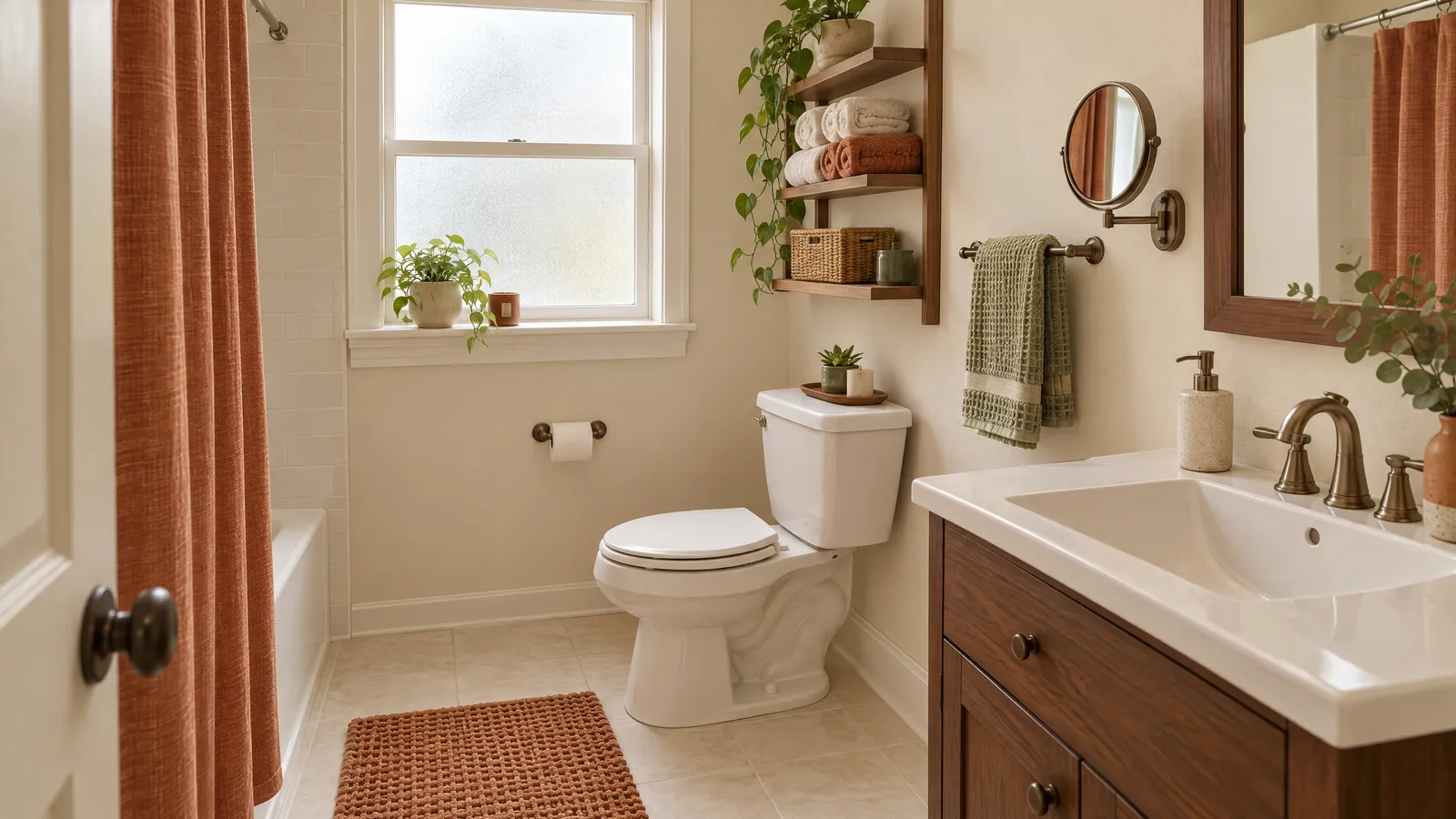
The problem
A typical small full bathroom is about 5 by 8 feet (1.5 x 2.4 m), and many older apartments fit one into 5 by 7. The tub alone is usually 60 inches long and 30 to 32 inches from front to back (152 x 76 to 81 cm). Add the toilet and sink, and the open floor that’s left is often barely bigger than one bath mat.
That floor has rules. US building codes typically call for at least 21 inches (53 cm) of clear space in front of the toilet, and 30 inches (76 cm) is what feels comfortable. Every rug, bin and laundry basket competes for that same strip, and the door has to swing through it too.
Storage is the next squeeze. A pedestal sink has no cabinet at all, and a small vanity is often 18 to 24 inches (46 to 61 cm) wide with the drain pipe taking the middle. So bottles pile up on the tank lid, the window sill and the edge of the tub.
Then there’s moisture. Plenty of small bathrooms have a weak fan or none, so thick towels and plush rugs stay damp for hours, start to smell and can grow mildew on the backing. And if you rent, you usually can’t add a cabinet, a second towel bar or new holes in the tile without asking first.
The plan
-
Measure the floor you actually stand on. Measure from the front of the toilet to the wall or tub opposite, and from the tub edge to the vanity, then open the door and note where it sweeps. A mat has to sit inside that space with the door clearing it; a mat the door catches on bunches up and becomes a trip hazard. Write the numbers down before you shop for anything.
-
Move bottles off the counter and into the cabinet. If you have a vanity, the space under the sink can hold most of what sits on the counter once you work around the pipes; our guide to under-sink organization covers U-shaped drawers and door racks that fit. Keep only daily items on the counter, ideally on one small tray you can lift to wipe underneath.
-
Use the wall above the toilet. The wall over the tank is usually the largest empty surface in the room. A suspended wall shelf about 6 to 8 inches (15 to 20 cm) deep holds spare rolls, a stack of towels and a plant without touching the floor. Leave at least 12 inches (30 cm) above the tank so you can lift the lid off for repairs, and fix the shelf into studs or anchors rated for the loaded weight. In a rental, ask before drilling, or use a freestanding over-the-toilet unit instead.
-
Clear the tub edge with a caddy that doesn’t drill. Shampoo bottles lined up on the tub rim fall in, collect soap scum and make the tub look smaller. A tension-pole caddy wedges between the tub and the ceiling, so measure that height and check it against the pole’s range before you buy. Suction and adhesive caddies can let go in a hot, steamy shower, so stay well under their weight rating and keep heavy refill bottles in the cabinet.
-
Pick one rug plan and stop it sliding. In a 5-by-7 bath, one mat in front of the tub may be all the floor allows; in a 5-by-8 you can add a contour rug at the toilet so the floor looks planned. Our guide to choosing a bath rug set covers sizes: a common tub mat is about 20 by 32 inches (51 x 81 cm), and 17 by 24 inches (43 x 61 cm) suits tighter floors. If your fan is weak, waffle bath rugs are thinner than plush pile and dry faster. On smooth tile, put a non-slip pad under any rug without a grippy back, and check your floor’s care advice first, since some rubber backings can discolor vinyl.
-
Choose towels that dry between uses. A hand towel is usually about 16 by 30 inches (41 x 76 cm), small enough for a short bar or a 6- to 8-inch (15 to 20 cm) ring beside the sink. Thick, plush towels (often 600 GSM or more) can stay damp all day in a steamy room, which is why lighter quick-drying hand towels suit a bathroom without a window. Hang towels spread flat rather than bunched, and keep a second set so one can always be in the wash.
-
Add a mirror for close work, out of the sun. The cabinet mirror is often too far away for contact lenses, tweezing or shaving. A magnifying vanity mirror on a small stand or a suction mount brings that detail to arm’s length without drilling. Keep any magnifying mirror out of direct sunlight, including on a window sill: like a magnifying glass, it can focus the sun onto something nearby and start a fire.
-
Get the moisture out, then deal with smell. Run the fan during the shower and for 20 to 30 minutes after, or leave the door and window open if there’s no fan; drying the room does more for smell than anything you can buy. For a windowless room, a reed diffuser gives a steady, low scent with no power and no flame. Set it where it can’t be knocked over, since the oil can mark painted and wood surfaces, and keep it out of reach of children and pets: some essential oils are harmful to cats and dogs.
Before you shop
- Clear floor in front of the tub or shower and in front of the toilet, with the door open.
- Width of the wall above the toilet, and the height from the top of the tank to the ceiling.
- Length of your towel bar, or the inside width of your towel ring.
- Inside width, depth and height of the under-sink cabinet, and where the pipes sit.
- Floor type (glazed tile, vinyl, a heated floor) before you choose a rug backing or pad.
- What your lease says about drilling, adhesive hooks and replacing fixtures.
The guides for this room
- 3-Piece Bathroom Rug Sets Updating — Coordinated rugs make a small floor look planned.
- Waffle Bath Rugs Updating — Thin, fast-drying rugs for a bathroom without a fan.
- Budget Bath Mats Updating — A cheap mat you can wash every week.
- Non-Slip Rug Mats Updating — Stops rugs sliding on smooth tile.
- Bathroom Hand Towels Updating — Hand towels sized for a short bar or ring.
- Quick-Drying Hand Towels Updating — Towels that dry between uses in a steamy room.
- Suspended Wall Shelves Updating — Uses the empty wall above the toilet, not the floor.
- Magnifying Vanity Mirrors Updating — A small magnifying mirror for close-up tasks.
- Reed Diffusers with Essential Oils Updating — Steady scent for a windowless bathroom, no power needed.